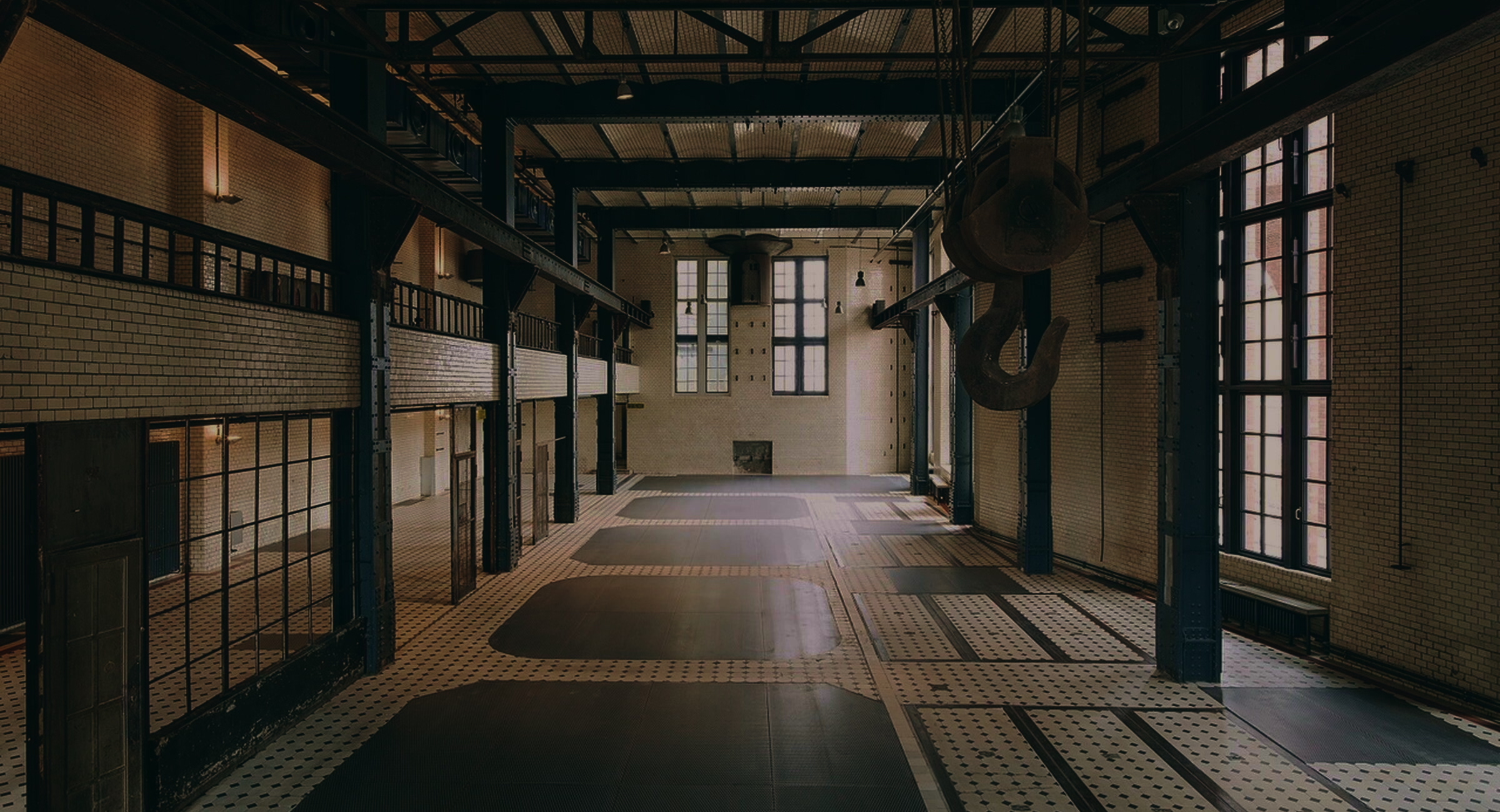
E-Werk Archive / Berlin

Interior of E-Werk's tiled industrial hall with its suspended crane hook.
E-Werk hall. Source / credit: Juliane Eirich / E-Werk. [visit archive]

1993

first move

1997

closure

mitte

district

01 / Building

former power infrastructure reused as a club, not disguised as one Source / credit: Andreas Nenninger Photography (public use). [visit archive]
interior lighting photographed by Martin Eberle inside the hall Source / credit: Martin Eberle (published in book). [visit archive]

building

The Old Power Plant.

What made the building special, was that it was not a club made to imitate industrial roughness. It was a former electrical complex with a tall tiled hall, improvised passages, and two connected floors that invited people to keep moving through it. The operators treated the whole structure like a living environment, filling it with light works, painted surfaces, large sculptural elements, and a sound that felt unusually full and balanced for a space of that scale.

people

A Mixed, Colorful, and Open Crowd.

Witnesses remember E-Werk as a place where very different people came together, with a crowd that felt more mixed, more colorful, and more open than in many other clubs of the time, especially through the strong presence of Berlin’s gay and drag communities. It was not just a place to dance but a meeting point for ravers, artists, technicians, and older night owls alike, all drawn together by the music and the atmosphere.

location

Exceptional Before Anyone Stepped Inside.

Its position near Potsdamer Platz, right on the edge of the former Wall strip, made it easy to reach from both old West Berlin and the new club routes through Mitte. People moved between nearby clubs on foot or by bike, with E-Werk acting as one of the big magnets in that circuit. The location was part of its power: central, porous, and close to the fault lines that had only recently divided the city.

legacy

Unpaid Location Scouts.

A Telepolis article from 2001 The operators of clubs like E-Werk did more than stage nights. In the 1990s they tested abandoned industrial sites and showed how these buildings could function as spaces of cultural and creative production. Later investors and developers would reuse that visual language and spatial logic, turning the roughness once discovered through club culture into a marketable image.

02 / Spaces

Two Spaces - One mind flyer pages Source / credit: E-Werk / Chromapark. [visit archive]

03 / Witnesses

Elsa for Toys

for E-Werk

Elsa organized the techno-art exhibition series Chromapark (1994–1996)

about

Berlin-based media artist known for large-scale visual installations in the early 1990s techno scene.

Elsa was a co-founder of Chromapark. She stresses that she was not responsible for E-Werk itself, but part of the artistic and implementation team.

Angelo Plate

for E-Werk

From the beginning Angelo designed, installed, and maintained the sound system, checked locations, and stayed tied to the building through its later rebuild.

about

Sound and production lead; owner of SATURN Production.

I was a sound technician then. From the beginning, I did the sound design for the system, installed it completely, and looked after it throughout E-Werk's entire run.

Interview transcript with Angelo

Marc Wohlrabe

for E-Werk

Flyer actively tracked the parties at E-Werk including Chromapark. Marc was also a passionate E-Werk visitor.

about

Berlin nightlife publisher behind Flyer Magazine and former Berlin Clubcommission member.

Watch Marc’s introduction
Marc introduces himself, places Flyer Magazine in Berlin nightlife, and explains why E-Werk mattered to him. Source / credit: Aleksandra Klushina (CC BY-NC). [visit archive]

Planet Starts as a Moving Club

Planet was one of the key early Berlin techno clubs, active roughly from March 1991 to 1993. Multiple scene histories describe it as an early center of post-Wall Berlin club culture. Compared with Tresor, it’s often remembered as warmer, more colorful, more melodic, and more queer in atmosphere. Residents associated with Planet included Dr. Motte, Jonzon, Terrible, and later Disko and Woody.

At Köpenicker Straße Planet quickly becomes one of the rooms where the still-young post-Wall club scene finds a weekly rhythm. It was not a fixed institution yet. The crew built the night into the space, ran it, and stripped it back down by morning. Planet is the prehistory of E-Werk: the same network learning how to test locations, move equipment, and turn temporary rooms into scenes.

Planet was always the classic routine. Build up at noon, the party starts — have a drink, join in for a bit, then head home at nine in the evening and come back at five in the morning to tear it all down.

Angelo on Planet's weekly rhythm
Planet flyer, 1991. Source / credit: Ralf Regitz (CC BY-NC). [visit archive]

Finding the Shell

In the summer of 1992, Planet lost its lease at Köpenicker Straße and moved east again to Alt-Stralau. The second Planet was larger and much farther from the center, and the crowd improvised its own routes there, including shuttle Trabbis running over from Tresor.

That same year, Andreas Rossmann and Ralf Regitz found another possibility in Mitte: the abandoned Abspannwerk Buchhändlerhof on Mauerstraße. The listed BEWAG substation had been shut down in the 1980s and was still being used as a depot for street lamps until 1991. E-Werk did not begin as a polished club concept. It began when the Planet crew recognized that this former piece of power infrastructure could be used again, this time for nightlife.

Elsa was not sure how long Alt-Stralau even lasted, but she would have been surprised if it was more than a year. It had a few packed months before it completely went downhill.

Elsa for Toys on Planet at Alt-Stralau
E-Werk inner courtyard. Source / credit: Henrik Andree, personal photography. [visit archive]

A Test Party Inside the Machine

The first step into the former substation came in February 1993 with the Evidence Party in what is now Hall F. Low Spirit and WestBam were involved, and almost none of the later club infrastructure was in place yet.

What people encountered was closer to a trial run than a finished opening. Contemporary accounts remember hard, fast music, open fire installations, and a space that still carried an illegal warehouse feel. The success of that night made it clear that the building could work as more than a one-off.

E-Werk main hall before full conversion, early 1993. Source / credit: Henrik Andree. [visit archive]

Planet Becomes E-Werk

After the February trial run, the plan moved quickly. In April 1993, Planet relocated into E-Werk and took its new name from the obsolete power station it had occupied.

The move did not erase what came before. It reorganized it. Dubmission moved into the Friday slot, while Twirl became the new Saturday party and quickly turned E-Werk into a weekend destination. What had started as Planet’s search for another room now had a fixed address, a recurring program, and a scale that set it apart from the smaller clubs around it.

E-Werk hosted major residents and guests including Westbam, Clé, Woody, Jonzon, Paul van Dyk, Sven Väth, DJ Hell, Derrick May, Juan Atkins, and others.

Press clipping on Planet's move into E-Werk. Source / credit: Frontpage / Technohistory.org (open access). [visit archive]

Twirl flyer from E-Werk's first official months. Source / credit: Creator not identified / Berlin Techno Archive. [visit archive]

SoundCloud

Loading connects to SoundCloud and may transmit your IP address and device information.

Clé and Woody at E-Werk, 31 July 1993. Source / credit: Clé and Woody; uploaded by corecracker on SoundCloud. [open on SoundCloud]
Marc Wohlrabe on why Dubmission drew him to E-Werk on Fridays. Source / credit: Aleksandra Klushina (CC BY-NC). [visit archive]
Marc Wohlrabe on Twirl as E-Werk's Saturday night. Source / credit: Aleksandra Klushina (CC BY-NC). [visit archive]

The Club Becomes an Institution

In 1994 the place settles into itself. The operation gets smoother, the routes through the building get clearer, and the nights start to move with less strain. As an example they opened the tunnel between Twirl and Evidence Hall and also introduced a chip system to make the payment faster.

It is also the year the outside world really notices. Bigger crowds, branded events, the first Chromapark. Elsa for Toys and Ralf Regitz are just two among many people behind the Chromapark concept. Music, installation, and media are staged as one environment instead of separate parts of the night.

Saturday was always Twirl day. Saturday was E-Werk — all the resident DJs: Udi, Motte, Disco, Kid Paul. And Sunday was Dubmission. It was always also the day when the queer scene celebrated at E-Werk. There were always two, running in parallel for a long time. Same location — but always a different crowd, always a different vibe.

Angelo on the weekend structure

YouTube

Loading connects to YouTube and may transmit your IP address and device information.

E-Werk footage, 1994. Source / credit: Uploaded by Video Stock Archives on YouTube. [open on YouTube]
Marusha performing at E-Werk. Source / credit: Creator unknown; all rights restricted. [visit archive]
E-Werk flyer announcing the chip payment system, November 1994. Source / credit: Glamour Crew (open licence). [visit archive]

SoundCloud

Loading connects to SoundCloud and may transmit your IP address and device information.

DJ Magic, Jonzon, and DJ Woody at E-Werk. Source / credit: DJ Magic, Jonzon, and DJ Woody; uploaded by Andreas W on SoundCloud. [open on SoundCloud]

Evidence Hall Becomes a Special-Events Room

By late 1994 the separate hall is no longer just extra space. It is being used for outside productions, branded nights, and the kind of events that sit slightly apart from the club’s ordinary weekly pulse.

Versace had already passed through that register. Then came the MTV Awards after-show. Elsa remembers working more than partying, turning the hall into a jungle while guests and supermodels moved through a room that had barely existed as a regular floor before.

Backstage pass from the MTV Music Awards after-show at E-Werk. Source / credit: Creator not identified / E-Werk. [visit archive]

Chromapark Returns in a Clearer Form

The first Chromapark had already happened in 1994. By spring 1995 it comes back in a form that is easier to read from the surviving material: exhibition language, daily print, named artists, club nights that look like parts of one larger program.

This is less the beginning than the point where the format sharpens. For a while the building itself becomes the event frame. People move through it, look at it, dance inside it, and take in music, installation, and media as one route.

But in the technical team at Chroma Park, things stepped up another level, because then the question was: how do we organize an event like this in the first place? How does it work with these artist applications? How do you turn that into a format you can map onto a budget?

Angelo on organizing Chroma Park
Interview clip on Chromapark's immersive character. Source / credit: Aleksandra Klushina (CC BY-NC). [visit archive]

Chromapark booklet spread. Source / credit: E-Werk / Planetcom (public use). [visit archive]

Raveline coverage of Chromapark. Source / credit: Raveline / Technohistory.org (open access). [visit archive]

Daily Flyer Chromapark 95, front, 13 April 1995. Source / credit: Marc Wohlrabe and contributors. [visit archive]

Daily Flyer Chromapark 95, back, 13 April 1995. Source / credit: Marc Wohlrabe and contributors. [visit archive]

Innovation Under Pressure

By late 1995, the room is still inventive, but something has shifted. The programming looks more systematized. A regular “Fridays” series now anchors the week, consistent and branded. A website has appeared: Techno.Net, offering event info and merchandise, a digital address for something that once lived only in the moment. The branding is harder to miss. The city around the club is getting more expensive, more watched, more tense.

The easy momentum is gone. The pressure is no longer outside the frame. It is already in the room.

It was basically a competition where, as an artist, you could submit work. Then submissions suddenly started coming in, and the exhibition concept had to be developed. And of course there was also the whole question of selection: what do we take, what do we leave out, and what can we afford or not afford? And it had to be party-compatible. That meant it was an exhibition during the day, and then at, I don't know, 7 or 8 in the evening, the doors closed, everyone out, rebuild, and at night people partied all the way through until morning. And the environment, the art, stayed.

Angelo on how Chroma Park was structured

Techno.Net Fridays flyer. Source / credit: Creator not identified (open access). [visit archive]

Der Spiegel coverage of Berlin's club crisis. Source / credit: Der Spiegel; all rights reserved, archival/educational use. [visit archive]

Brand Logic Comes to the Surface

By late 1995 the commercial layer is no longer background noise. West Sound Circle is one visible trace of it, a quadrophonic audio spectacle in December sponsored by West cigarettes, but not the whole story. Bugatti, MTV Club Tour, sponsored formats, corporate hospitality. The room is still inventive, but it is being packaged more openly now. That is what gives the period its doubleness. E-Werk can still do things other clubs cannot do. But money, image, and access are now part of the room as well, and the club stands caught between pioneering something and being reshaped by the market forces closing in around Berlin’s center.

West Sound Circle release, front cover. Source / credit: Interferenze; artwork by The Designers Republic; all rights reserved. [visit archive]

West Sound Circle release, back cover. Source / credit: Interferenze; artwork by The Designers Republic; all rights reserved. [visit archive]

96 Hours Open

Chromapark ‘96 feels like excess in the best sense. Ten days. More than forty artists. Ninety-six hours open from Thursday onward. Launches, installations, parties, projections, people crossing paths at all hours. E-Werk reached one of its clearest high points as a space where club culture, visual art, and performance fully merged. Installations, projections, fashion, and live interventions, while the venue remained open for marathon stretches that blurred the line between exhibition and nightlife.

For a moment, E-Werk felt less like a club and more like a living cultural environment at the center of Berlin’s techno scene.

From 1996 on, the focus shifted more toward the Love Parade. And the Love Parade was basically a complete full-time job, especially for Planetcom and Ralf [Regitz]. Techno culture kept expanding, until around 1999 or 2000 the Love Parade hit its peak. It became more and more commercial, more and more professional, and that was when the people who had driven it before somehow lost their fascination with it.

Angelo on the shift toward the Love Parade

Camel Club Move flyer from Chromapark 96. Source / credit: Creator not identified (CC BY-NC). [visit archive]

Raveline coverage of Chromapark. Source / credit: Raveline / Technohistory.org (open access). [visit archive]

SoundCloud

Loading connects to SoundCloud and may transmit your IP address and device information.

Terrence Parker live at E-Werk. Source / credit: Terrence Parker; uploaded by Must Have - Sets on SoundCloud. [open on SoundCloud]

Shifting Atmospheres at E-Werk

By the second half of 1996, the atmosphere at E-Werk had noticeably changed. The club had become more commercial, and there was a stronger presence of gangs and dealers around the venue. At the same time, stricter entry policies meant that people often gathered outside either because they couldn’t get in or simply because they liked it there.

Staff members described increasing pressure and tension within the team. The armed robbery of the club’s offices, mentioned briefly by Angelo and echoed in other accounts from the period, marked a moment when these developments became visible. In retrospect, it showed how E-Werk was turning into a space of conflicting interests toward the end of its run.

Der Raubüberfall mit Geiselnahme, das war ein Einschnitt.

Angelo on the robbery as a turning point
Interview clip on E-Werk's door policy in its late phase. Source / credit: Aleksandra Klushina (CC BY-NC). [visit archive]

The Long Goodbye

By 1997 the ending is already underway. E-Werk does not vanish in a single gesture. New interest and investment in the central areas of Berlin is making it harder for E-Werk to sustain itself. After the financial chaos of three Chromaparks, a fourth edition did not take place. Instead a party called “chocolate bunny days” happened on the Easter weekend.

In the September issue of Raveline, the closure of E-Werk was announced. The article also hints at plans from PLANETCOM to continue its activities after E-Werk’s closure. The last known event to take place at E-Werk was the Don Giovanni opera running from 09.08 to 13.09 ‘97, which already foreshadowed the buildings continued use as an event location.

It kept getting more difficult in terms of the neighbors. Then construction started too, and there was this building where some wealthy people had their apartments. So the whole environment became more and more difficult. In the end, that was the point when it became clear that this was coming to an end here. And of course Ralf [Regitz] then tried to transfer it to a new location. But that only worked to a limited extent.

Angelo Plate

YouTube

Loading connects to YouTube and may transmit your IP address and device information.

E-Werk closing footage, 1997. Source / credit: Uploaded by klangfunk on YouTube. [open on YouTube]
Interview clip reflecting on the loss of E-Werk. Source / credit: Aleksandra Klushina (CC BY-NC). [visit archive]

Raveline party review, late summer 1997. Source / credit: Raveline Magazine. [visit archive]

Raveline report on E-Werk's closure, 1997. Source / credit: Raveline Magazine. [visit archive]

SoundCloud

Loading connects to SoundCloud and may transmit your IP address and device information.

DJ Disko, Clé, and WestBam live at the E-Werk closing party. Source / credit: DJ Disko, Clé, and WestBam; uploaded by Andreas W on SoundCloud. [open on SoundCloud]

05 / Legacy